

If you've talked to more than one recruiting firm, you've probably heard both pitches. One says you only pay when you hire. The other wants a check before they start, and says that's exactly why they'll do a better job.
Both can be right. It depends on the role.
The short answer: use contingency for most roles, especially when you're hiring more than one person or the role isn't confidential. Use retained for senior, confidential or very hard searches where you need one firm fully committed. And if fees are the main thing stopping you from using an agency at all, there's a third option at the end.
What contingency recruiting means
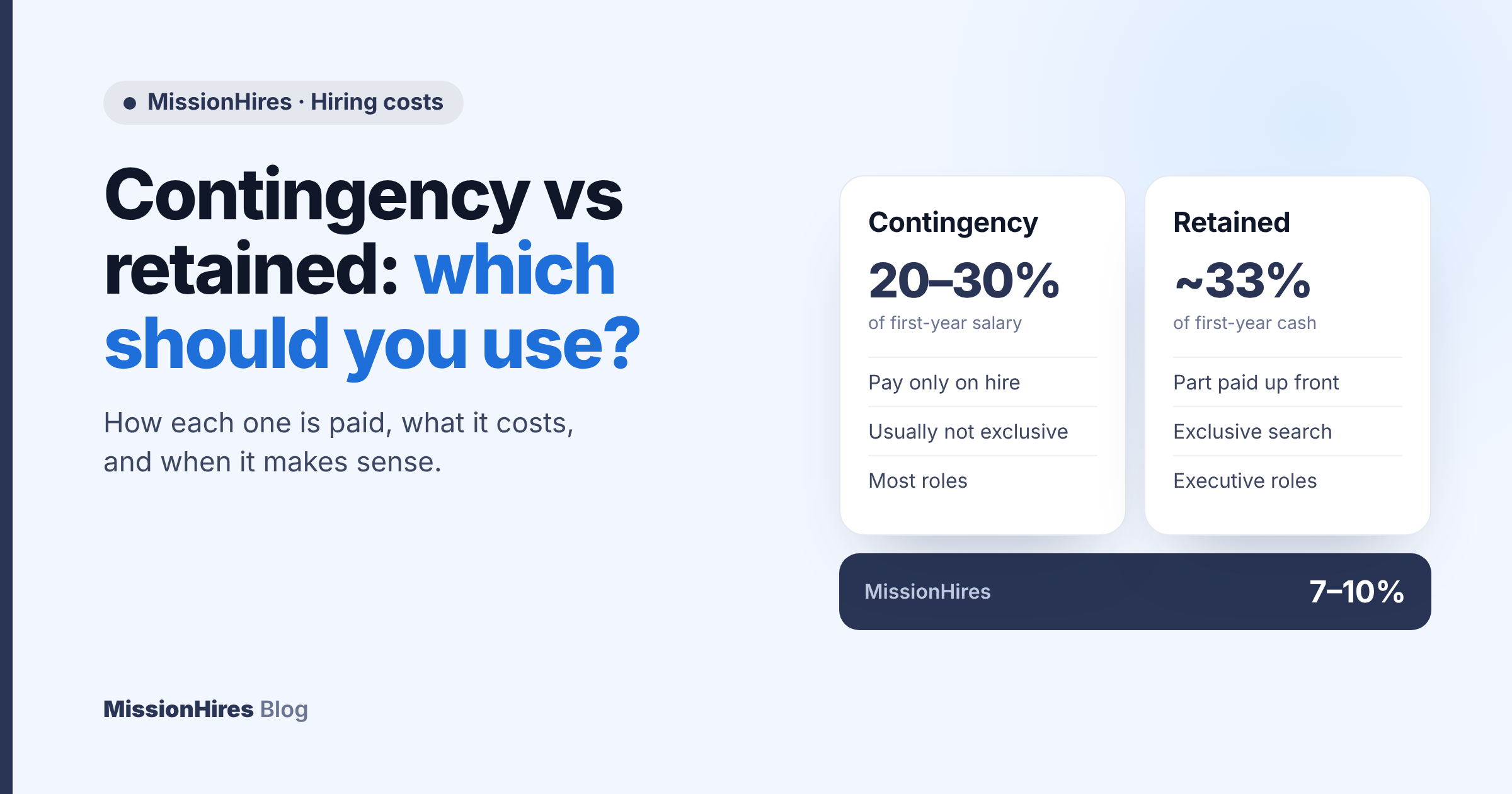
A contingency recruiter gets paid only if you hire someone they sent you. No hire, no fee. The fee is a percentage of the new hire's first-year salary, usually 20 to 30% in the US. Robert Walters in New York, for example, defaults to 30% (HeroHunt).
Most contingency agreements also include a guarantee. If the hire leaves early, you get a replacement or a partial refund. Robert Half, for example, offers a 90-day guarantee on permanent placements (HeroHunt).
The catch is commitment. You can give the same role to three agencies, and they know it. So they'll often send whoever they can find fastest, and they'll put more energy into the roles most likely to close.
What retained recruiting means
A retained search firm gets paid part of the fee up front to run the search, usually as the only firm on it. The fee is typically about a third of first-year cash compensation, often paid in installments. Heidrick & Struggles, for example, bills in one-third increments over three months (HeroHunt).
You're paying for a dedicated process: market mapping, a researched shortlist, reference checks and a lot of hand-holding. The first payment is usually non-refundable, so you pay it even if you end up not hiring.
Contingency vs retained, side by side
On a $100,000 hire, that's roughly $20,000 to $30,000 with a contingency firm and around $33,000 with a retained one.
When to use contingency
- You're hiring individual contributors or managers, not the C-suite.
- You have several openings at once, or the same role repeats.
- The role isn't confidential, and it's fine if the market knows you're hiring.
- You want to keep the option of hiring someone you find yourself without owing a fee.
When to use retained
- It's an executive or board-level role where a bad hire costs far more than the fee.
- The search is confidential, for example replacing someone who's still in the seat.
- The pool is tiny and you need someone to map every possible candidate, not just the ones who are looking.
- You want one accountable partner running a structured process, start to finish.
A third option: lower fees, same service
Most employers pick between these two because they think those are the only choices. They're not.
At MissionHires we charge 7 to 10% of first-year salary instead of 20 to 30%. Our AI platform handles sourcing, outreach and pre-screening, which is where most recruiter hours go, so our recruiters spend their time on qualified candidates and on you. You still get a dedicated recruiter on your search. And if we don't bring you results in 7 days, we walk away.
On that same $100,000 hire, that's $7,000 to $10,000 instead of $20,000 to $33,000. We go deeper on the math in Why We Charge 7–10% When Most Recruiting Agencies Charge 20–30%.
We're not the right fit for a confidential CEO search. That's what retained firms are for. For almost everything else, it's worth a conversation.
Frequently asked questions
What is the difference between contingency and retained recruiting?
A contingency recruiter is paid only when you hire someone they sent you. A retained recruiter is paid part of the fee up front to run an exclusive search, usually for senior or confidential roles.
How much do contingency recruiters charge?
In the US, contingency fees are usually 20 to 30% of the new hire's first-year salary. Some firms charge less. MissionHires charges 7 to 10%.
Is retained search better than contingency?
Not by default. Retained search is better for executive and confidential roles where one dedicated firm matters. For most other roles, contingency or a low-fee agency is faster and costs less.
