

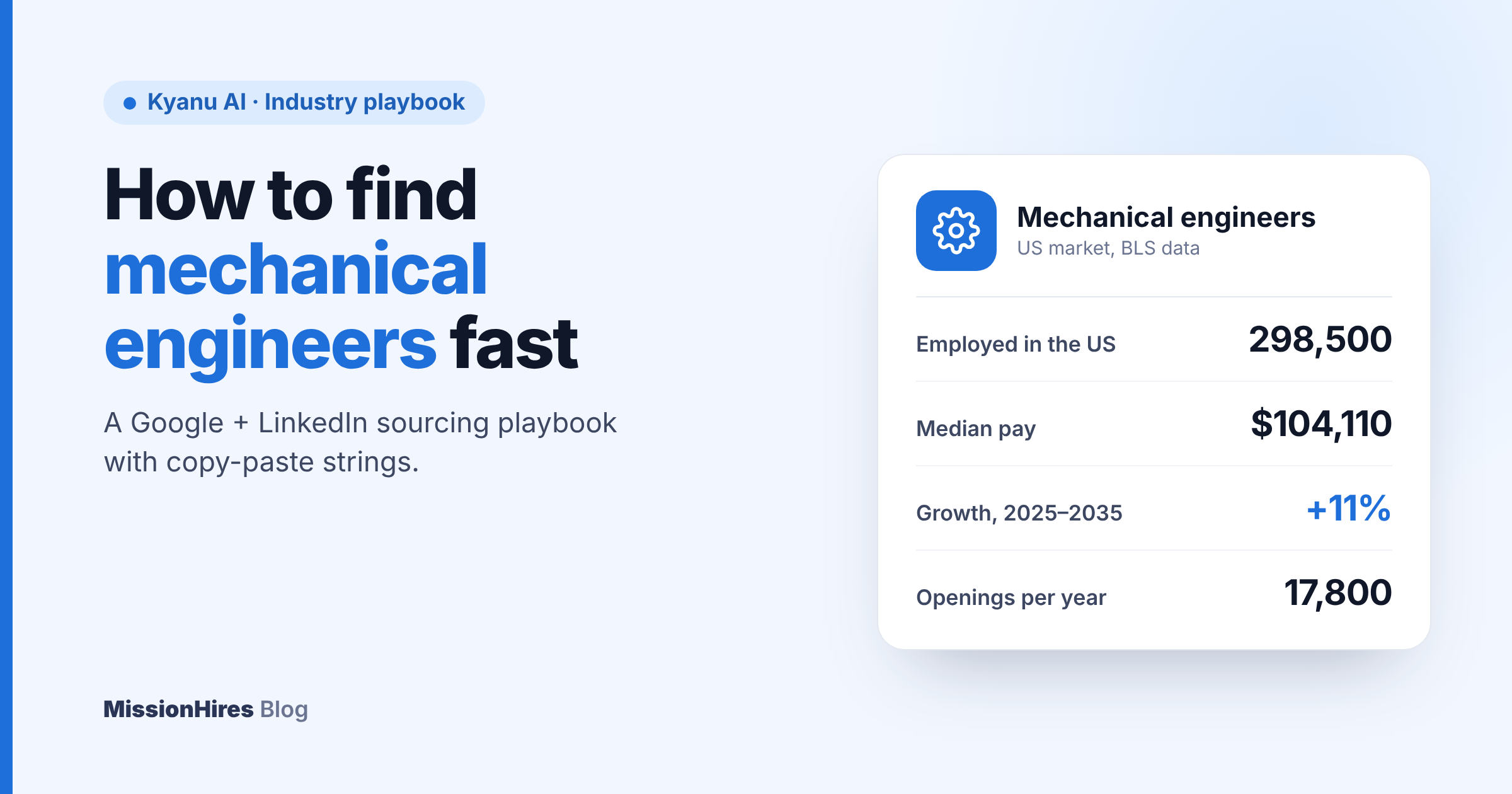
Mechanical engineers are one of those searches that looks easy on paper. There are about 298,500 of them in the US, and employment is projected to grow 11% from 2025 to 2035, with roughly 17,800 openings a year (BLS). Plenty of people, right?
Then you open LinkedIn and find out every one of them already has five recruiters in their inbox. And the ones you actually want, the HVAC design engineer with a PE license or the product engineer who lives in SolidWorks, often have a two-line profile they haven't touched since 2019.
Engineering is one of our core verticals at MissionHires, so this is the playbook I'd hand any recruiter working one of these roles: how to read the req, where to look on Google, how to search LinkedIn without burning your day, and what to say so engineers write back.
Step 1: Know which mechanical engineer you're hiring
"Mechanical engineer" covers very different jobs. Before you search, figure out which one the hiring manager means. It changes the titles, tools and places you'll look.
Two credentials are worth knowing:
- PE (Professional Engineer). Not needed for entry-level work, but required for engineers who sign off on designs for the public, which is common in HVAC/MEP and building work. It usually takes an accredited degree, the FE exam, about four years of experience and the PE exam (BLS).
- EIT or EI (Engineer in Training). Someone who passed the FE exam and is on the way to a PE. Great for "high potential, two to four years in" roles.
Ask the hiring manager one question that saves a week: "What will this person design, build or fix in their first 90 days?" The answer tells you which row of that table you're in.
Step 2: Search Google first (the people LinkedIn hides)
Google X-ray search finds engineers outside LinkedIn: resumes, portfolios, company team pages and CAD communities. Copy these, swap in your city and specialty, and keep the exclusions at the end.
Two tips for engineering searches: add the software (SolidWorks, Revit, CATIA) instead of more job titles, because engineers list tools far more consistently than titles. And search the metro, not just the city. A Fort Worth engineer may write "DFW" or "Arlington".
Step 3: Search LinkedIn the smart way
LinkedIn is still where most engineers have a profile, so you'll end up there. The goal is to spend fewer searches and open fewer dead-end profiles.
Step 4: Write to engineers like an engineer would
Engineers delete vague messages fast. What works is specific and short:
- Lead with the work, not the company. "You'd own the HVAC design for three hospital projects in San Antonio" beats "a fast-growing firm is hiring".
- Name the tools and the stage. If they'll be in Revit on design-build jobs, say so. It tells them you read their profile.
- Put the range in the first message. The median mechanical engineer earns about $104,000 a year (BLS). If your role pays above that, lead with it.
- Mention the PE path. For EITs, a firm that supports PE licensing (study time, exam fees, PE supervision) is a real selling point.
- Use email, not just InMail. Many engineers rarely check LinkedIn. A personal email often gets read the same day.
A message that works:
Hi Maria, saw your HVAC design work on healthcare projects. I'm working on a Senior Mechanical Engineer role with an MEP firm in San Antonio: Revit, hospital and lab projects, $115K–$130K, and they'll cover your PE exam. Worth a 10-minute call this week?
Do it faster with Kyanu AI
Everything above works. It's also a lot of clicking: run a string, open twenty results, read each page, decide who fits, then hunt for an email.
Kyanu AI is a Chrome extension that does that part for you. Paste the public job post for your mechanical engineer role, and it sources candidates on Google with a pre-qualification score against the job on every result. You see right away who has the PE, the SolidWorks or the HVAC background before you click, and contact info is in the same place.
Google sourcing is on every plan, including the free one.
Add Kyanu AI to Chrome, it's free
Frequently asked questions
Where is the best place to find mechanical engineers?
Start with LinkedIn for reach, then use Google X-ray search to find engineers with thin LinkedIn profiles: resumes, MEP and manufacturing firm team pages, and CAD communities like GrabCAD.
What should I search for when sourcing mechanical engineers?
Search by software and specialty, not just title. SolidWorks or Creo for product design, Revit and HVAC for MEP design, and PE or EIT when licensing matters.
Do mechanical engineers need a PE license?
Not for entry-level work. A PE is required for engineers who offer services directly to the public, and it's common in HVAC, MEP and building design roles.
How do I get mechanical engineers to reply?
Lead with the actual work and tools, include the salary range in the first message, mention PE support for engineers in training, and send to a personal email instead of relying only on InMail.